
Can Floating Shelves Hold Books? Weight and Safety
You’re eyeing a bare wall and a stack of paperbacks, wondering if a sleek floating shelf will actually hold up or leave you with a...

You’re eyeing a bare wall and a stack of paperbacks, wondering if a sleek floating shelf will actually hold up or leave you with a pile of books and a cracked bracket on the floor. That worry is fair. Bookshelves take real punishment, and a badly mounted floating shelf can pull right out of drywall.
Floating shelves can hold books safely, but the amount depends on the wall anchor, bracket, and shelf material working together, not just the shelf itself. A shelf mounted into wall studs can carry far more weight than one held up by drywall anchors alone. Get the mounting right and a floating shelf handles a solid row of hardcovers without sagging or pulling loose.
A floating shelf’s real capacity comes down to four things working together: the wall material it’s anchored into, the number and spacing of attachment points, the shelf’s own thickness and span, and the actual weight of the books you plan to load. Skip any one of these and the manufacturer’s rating on the box stops meaning much.
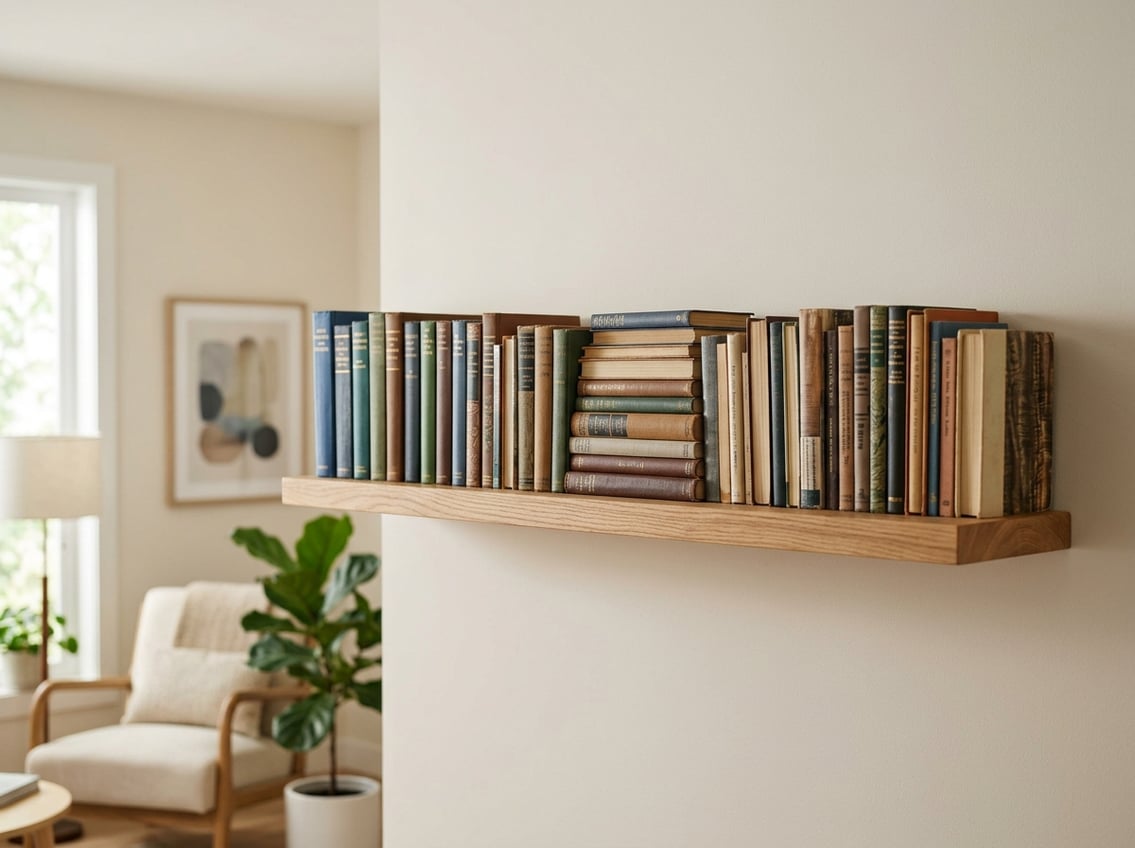
A floating shelf anchored properly into a wall stud can support 40 to 50 pounds per attachment point, according to Shelfology’s load testing. That means a 3-foot shelf secured to two studs can often hold close to 100 pounds, enough for two to three dozen average hardcovers.
Some sources put the range even wider. One installation guide notes that floating shelves generally support between 25 and 75 pounds depending on the mounting hardware and wall type, while heavier-duty bracket systems tested by Citainterior claim capacities from 10 up to 200-plus pounds. The wide spread tells you the shelf alone isn’t the deciding factor.
Drywall alone can’t carry serious weight. A shelf relying only on a plastic drywall anchor, with no stud or masonry connection, can drop to under 25 pounds of safe capacity, even if the same shelf would hold 100 pounds when anchored into studs, according to Woodworking Advisor’s testing breakdown.
Studs and masonry give the bracket something solid to bite into. Drywall is just a thin panel; it crumbles under sustained pull-out force, which is exactly what a shelf full of books applies every day.
Thicker, denser shelf material resists sagging better than thin MDF over a long span. A short, thick solid-wood shelf holds more than a long, thin one, even with identical brackets, because the wood itself has to resist bending under load, not just the connection to the wall.
Depth matters too. A deeper shelf gives books more surface contact and better balance, reducing the chance of front-heavy tipping when the shelf is loaded to the edge.
Average hardcovers weigh around 1 to 2 pounds each, and paperbacks weigh less, often under a pound. A tightly packed 3-foot shelf might hold 25 to 35 average books, which puts the total weight somewhere between 30 and 60 pounds, well within range for a stud-mounted shelf but pushing the limit for a drywall-anchor-only setup.
Textbooks and oversized art books run heavier, sometimes 3 to 5 pounds apiece, so a shelf of coffee-table books can hit its weight limit with far fewer titles than a shelf of pocket novels.
Picking the right shelf for books means checking material, bracket count, and mounting method before installation, not just liking the look on the shelf. It also means knowing what overload looks like once books are loaded, so you can catch a problem before the shelf fails.
A shelf suitable for heavy books is thick (usually 1.5 inches or more), made from solid wood or a dense engineered material, and rated for a specific weight by the manufacturer. Thin, hollow, or particle-board shelves flex under load and are a poor match for a dense row of hardcovers.
Check the listed load rating before buying, and treat it as a best-case number that assumes ideal wall conditions, not a guarantee for your specific wall.
Longer shelves need more attachment points to distribute weight evenly. A 2-foot shelf might need two studs, while a 4-foot shelf spanning heavier loads often needs three or more anchor points to avoid sagging in the middle.
More contact points spread the load, which reduces stress on any single anchor and lowers the risk of the bracket pulling free over time.
Bracket-free or minimal-hardware shelves work fine for lightweight decor, but they’re a poor fit for dense book collections. Without a robust bracket system anchored into structural framing, these designs rely on friction and small dowels that weren’t built to resist the constant downward pull of a full row of hardcovers.
If you’re building a home library wall, look for shelves specifically marketed with reinforced brackets rather than decorative floating designs meant for candles or small plants.
Watch for visible sag in the middle of the shelf, a gap opening between the shelf and the wall, or slight movement when you press down on the front edge. Any of these signs means the shelf is under more stress than the mounting can handle long-term.
Cracking sounds, drywall dust near the bracket, or the shelf tilting forward are more urgent warnings and mean you should remove some books immediately.
Distribute books evenly across the shelf’s length instead of stacking them all in the center or at one end. Place heavier books toward the back, closer to the wall, since weight nearer the bracket puts less leverage stress on the mounting point than weight hanging off the front edge.
Leave a small gap between the books and the front lip of the shelf to reduce front-loaded tipping risk, especially on shelves without a raised front edge.
Yes, floating shelves can hold books when they’re mounted into studs or masonry with a quality bracket system. A shelf relying only on drywall anchors is much weaker and should carry a lighter load, closer to paperbacks or a small stack rather than a full row of hardcovers.
Stud-mounted floating shelves typically support 40 to 50 pounds per attachment point, so a shelf anchored to two studs can often hold close to 100 pounds, based on Shelfology’s bracket testing. Shelves mounted with drywall anchors alone drop to a fraction of that, often under 25 pounds.
Yes, as long as the shelf is thick enough and properly anchored into studs or masonry. Hardcovers weigh 1 to 2 pounds each on average, so a densely packed shelf can approach 50 pounds quickly, which makes stud mounting important rather than optional.
Light loads are fine, but a full shelf of books isn’t a good match for drywall-anchor-only mounting. Capacity can fall under 25 pounds without a stud or masonry connection, which limits you to a small stack of paperbacks rather than a dense row of hardcovers.
Many floating shelves sold by major retailers, including IKEA, can hold books when installed according to the included hardware instructions and anchored into studs where possible. Always check the specific product’s weight rating and mounting requirements rather than assuming every floating shelf design performs the same.
Yes, a proper bracket system anchored into structural framing is what allows a floating shelf to carry meaningful book weight. Bracket-free or minimal-hardware designs are better suited to light decor items and aren’t built to resist the sustained pull-out force of a loaded book shelf.
 by